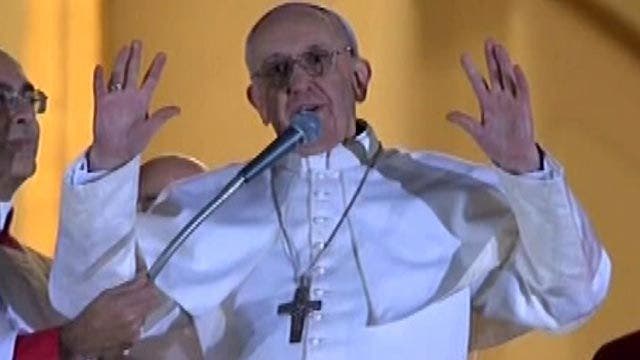
First Pope from the Americas

Argentine Cardinal Jorge Mario Bergoglio named new pope

Published March 14, 2013

FoxNews.com

Read more: http://www.foxnews.com/world/2013/03/14/world-watches-as-cardinals-convene-for-2nd-day-papal-conclave/#ixzz2NUAi7oan


Argentine Cardinal Jorge Mario Bergoglio was elected by his peers Wednesday as the new pope, becoming the first pontiff from the Americas.

He chose the name Francis, drawing connections to the humble 13th-century saint who saw his calling as trying to rebuild the church in a time of turmoil.

As the long-time archbishop of Buenos Aires, Francis has spent nearly his entire career at home in Argentina, overseeing churches and shoe-leather priests. In choosing a 76-year-old pope, the cardinals clearly decided that they didn’t need a vigorous, young pope who would reign for decades but rather a seasoned, popular and humble pastor who would draw followers to the faith and help rebuild a church stained by scandal.

Groups of supporters waved Argentine flags in St. Peter’s Square as Francis, wearing simple white robes, made his first public appearance as pope.

Chants of “Long live the pope!” arose from the throngs of faithful, many with tears in their eyes. Crowds went wild as the Vatican and Italian military bands marched through the square and up the steps of the basilica, followed by Swiss Guards in silver helmets and full regalia.

Francis appeared on the balcony of St. Peter’s Basilica just after a church official announced “Habemus Papum” — “We have a pope” — and gave Bergoglio’s name in Latin.

“Ladies and Gentlemen, good evening,” he said to wild cheers before making a reference to his roots in Latin America, which accounts for about 40 percent of the world’s Roman Catholics.

Francis asked for prayers for himself, and for retired Pope Emeritus Benedict XVI, whose surprising resignation paved the way for the conclave that brought the first Jesuit to the papacy.

“You know that the work of the conclave is to give a bishop to Rome,” Francis said. “It seems as if my brother cardinals went to find him from the end of the earth. Thank you for the welcome.”

In one of his first acts as pope, Francis on Thursday morning planned to visit Benedict at the papal retreat in Castel Gandolfo south of Rome.

American Cardinal Timothy Dolan said Wednesday night at the North American College, the U.S. seminary in Rome, that Francis told fellow cardinals following the conclave that made him pope: “Tomorrow morning, I’m going to visit Benedict.”

The visit is significant because Benedict’s resignation has raised concerns about potential power conflicts emerging from the peculiar situation of having a reigning pope and a retired one.

Bergoglio has shown a keen political sensibility as well as the kind of self-effacing humility that fellow cardinals value highly, according to his official biographer, Sergio Rubin. He showed that humility on Wednesday, saying that before he blessed the crowd he wanted their prayers for him and bowed his head.

“Good night, and have a good rest,” he said before going back into the palace.

In a lifetime of teaching and leading priests in Latin America, which has the largest share of the world’s Catholics, Francis has been known for modernizing an Argentine church that had been among the most conservative in Latin America.

Like other Jesuit intellectuals, Bergoglio has focused on social outreach. Catholics are still buzzing over his speech last year accusing fellow church officials of hypocrisy for forgetting that Jesus Christ bathed lepers and ate with prostitutes.

Francis, the son of middle-class Italian immigrants, is known as a humble man who denied himself the luxuries that previous Buenos Aires cardinals enjoyed. Bergoglio often rode the bus to work, cooked his own meals and regularly visited the slums that ring Argentina’s capital.

He came close to becoming pope in 2005, reportedly gaining the second-highest vote total in several rounds of voting before he bowed out of the running in the conclave that elected Pope Benedict XVI.

Cardinal Dolan gave an inside glimpse into the drama of the conclave in his talk at the American seminary.

When the tally reached the necessary 77 votes to make Bergoglio pope, Dolan said, the cardinals erupted in applause. And when he accepted the momentous responsibility thrust upon him — ”there wasn’t a dry eye in the place,” the American cardinal recounted.

After the princes of the church had congratulated the new pope one by one, other Vatican officials wanted to do the same, but Francis preferred to go outside and greet the throngs of faithful. ”Maybe we should go to the balcony first,” Dolan recalled the pope as saying.

In choosing to call himself Francis, the new pope was linking himself with the much-loved Italian saint from Assisi associated with peace, poverty and simplicity. St. Francis was born to a wealthy family but later renounced his wealth and founded the Franciscan order of friars; he wandered about the countryside preaching to the people in very simple language.

He was so famed for his sanctity that he was canonized just two years after his death in 1226.

St. Francis Xavier is another important namesake. One of the 16th century founders of the Jesuit order, Francis Xavier was a legendary missionary who spread the faith as far as India and Japan — giving the new pope’s name selection possibly further symbolic resonance in an age when the church is struggling to maintain its numbers.

Francis will celebrate his first Mass as pope in the Sistine Chapel on Thursday, and will be installed officially as pope on Tuesday, on the feast of St. Joseph, patron saint of the universal church, according to the Vatican spokesman the Rev. Federico Lombardi.

Lombardi, also a Jesuit, said he was particularly stunned by the election given that Jesuits typically shun positions of authority in the church, instead offering their work in service to those in power.

But Lombardi said that in accepting the election, Francis must have felt it “a strong call to service,” an antidote to all those who speculated that the papacy was about a search for power.

In an interesting twist the Jesuits were expelled from all of the Americas in the mid-18th century. Now, a Latin American Jesuit has been elected head of the 1.2-billion strong Catholic Church.

Tens of thousands of people who braved cold rain to watch the smokestack atop the Sistine Chapel jumped in joy when white smoke poured out a few minutes past 7 p.m., many shouting “Habemus Papam!” or “We have a pope!” — as the bells of St. Peter’s Basilica and churches across Rome pealed.

Elected on the fifth ballot, Francis was chosen in one of the fastest conclaves in years, remarkable given there was no clear front-runner going into the vote and that the church had been in turmoil following the upheaval unleashed by Benedict’s surprise resignation.

A winner must receive 77 votes, or two-thirds of the 115, to be named pope.

For comparison’s sake, Benedict was elected on the fourth ballot in 2005 — but he was the clear front-runner going into the vote. Pope John Paul II was elected on the eighth ballot in 1978 to become the first non-Italian pope in 455 years.

Bergoglio’s legacy as cardinal includes his efforts to repair the reputation of a church that lost many followers by failing to openly challenge Argentina’s murderous 1976-83 dictatorship. His own record as the head of the Jesuit order in Argentina at the time has been tarnished as well.

Many Argentines remain angry over the church’s acknowledged failure to openly confront a regime that was kidnapping and killing thousands of people as it sought to eliminate “subversive elements” in society. It’s one reason why more than two-thirds of Argentines describe themselves as Catholic, but fewer than 10 percent regularly attend mass.

Under Bergoglio’s leadership, Argentina’s bishops issued a collective apology in October 2012 for the church’s failures to protect its flock. But the statement blamed the era’s violence in roughly equal measure on both the junta and its enemies.

“Bergoglio has been very critical of human rights violations during the dictatorship, but he has always also criticized the leftist guerrillas; he doesn’t forget that side,” Rubin said.

Bergoglio’s own role in the so-called Dirty War has been the subject of controversy.

At least two court cases directly involved Bergoglio. One examined the torture of two of his Jesuit priests who were kidnapped in 1976 from the slums where they advocated liberation theology. One accused Bergoglio of effectively handing him over to the junta.

Both men were freed after Bergoglio took extraordinary, behind-the-scenes action to save them — including persuading dictator Jorge Videla’s family priest to call in sick so that Bergoglio himself could say Mass in the junta leader’s home, where he privately appealed for mercy. His intervention likely saved their lives, but Bergoglio never shared the details until Rubin interviewed him for a 2010 biography.

Rubin said failing to challenge the dictators was simply pragmatic at a time when so many people were getting killed, and attributed Bergoglio’s later reluctance to share his side of the story as a reflection of his humility.

Bergoglio also was accused of turning his back on a family that lost five relatives to state terror, including a young woman who was 5-months’ pregnant before she was kidnapped and eventually killed in 1977. The woman’s child, who survived, was given to an “important” family.

Despite written evidence indicating he knew the child had been given away, Bergoglio testified in 2010 that he didn’t know about any stolen babies until well after the dictatorship was over.

Unlike the confusion that reigned during the 2005 conclave, the smoke this time around has been clear: black during the first two rounds of burned ballots, and then a clear white on Wednesday night — thanks to special smoke flares akin to those used in soccer matches or protests that were lit in the chapel ovens.

The Vatican on Wednesday divulged the secret recipe used: potassium perchlorate, anthracene, which is a derivative of coal tar, and sulfur for the black smoke; potassium chlorate, lactose and a pine resin for the white smoke.

The chemicals are contained in five units of a cartridge that is placed inside the stove of the Sistine Chapel. When activated, the five blocks ignite one after another for about a minute apiece, creating the steady stream of smoke that accompanies the natural smoke from the burned ballot papers.

Despite the great plumes of smoke that poured out of the chimney, Lombardi said, neither the Sistine frescoes nor the cardinals inside the chapel suffered any smoke damage.

The Associated Press contributed to this report.


Overstepping their elected power?

Bloomberg… what a freakin’ idiot this guy is! Its none of his damned business what people eat or drink. Since when do elected officials know how best to run someone’s life? This ass of a politician needs to be thrown from office.


State judge halts Bloomberg ban on large sugary drinks in New York City

Published March 11, 2013

FoxNews.com

A New York judge is forcing the Bloomberg administration to take a big gulp — striking down its groundbreaking and controversial limit on the size of sugary drinks in New York City shortly before it was set to take effect.

Manhattan state Supreme Court Justice Milton Tingling wrote in his opinion that the rules are “arbitrary and capricious,” applying to only certain beverages and only certain stores.

“The loopholes in this rule effectively defeat the stated purpose of this rule,” he wrote, complaining of “uneven enforcement even within a particular City block, much less the City as a whole.”

Mayor Michael Bloomberg said the city plans to appeal, calling the ruling “clearly an error.”

“If we are serious about fighting obesity then we have to be honest about it and courageous about tackling it,” Bloomberg said. “We believe it is reasonable and responsible to draw a line.”

But Tingling said the city’s Board of Health went beyond its authority, and effectively would be “limited by its own imagination” if left unchecked.

“The portion cap rule, if upheld, would create an administrative Leviathan and violate the separation of powers doctrine,” by straying into territory that should belong to the elected City Council, not the board appointed by Bloomberg, Tingling wrote.

That, he wrote, “has the potential to be more troubling than sweetened beverages.

In the wake of the ruling, the American Beverage Association said the decision provided a “sigh of relief to New Yorkers and thousands of small businesses in New York City that would have been harmed by this arbitrary and unpopular ban.”

The city Board of Health approved the measure in September. Championed by Bloomberg, it follows on other efforts his administration has made to improve New Yorkers’ eating habits, from compelling chain restaurants to post calorie counts on their menus to barring artificial trans fats in restaurant food to prodding food manufacturers to use less salt. 

The city has said that while restaurant inspectors would start enforcing the soda size rule in March, they wouldn’t seek fines — $200 for a violation — until June.

Soda makers, restaurateurs, movie theater owners and other business groups sued, asking a judge to declare the measure invalid. In February, they asked Tingling to bar the city from enforcing the regulation while the suit played out.

City officials have called the size limit a pioneering move for public health. They point to the city’s rising obesity rate — about 24 percent of adults, up from 18 percent in 2002 — and to studies tying sugary drinks to weight gain. Care for obesity-related illnesses costs government health programs about $2.8 billion a year in New York City alone, according to city Health Commissioner Dr. Thomas Farley.

The supersize-drink crackdown will “have significant public health effects, and the sooner that happens, the better,” city lawyer Mark W. Muschenheim said in court in February.

Critics said the measure is too limited to make a meaningful impact on New Yorkers’ waistlines. But they said it would take a bite out of business for the eateries that have to comply, while other establishments still will get sell sugary drinks in 2-liter bottles and supersize cups.

Beverage makers had expected to spend about $600,000 changing bottles and labels, movie theater owners feared losing soda sales that account for 20 percent of their profits, and delis and restaurants would have had to change inventory, reprint menus and make other adjustments, according to court papers.

“These are costs which these businesses are not going to be compensated for,” and the money will be wasted if the court ultimately nixes the law, James E. Brandt, a lawyer for the American Beverage Association and other opponents, told the judge in February.

Critics also said the restriction should have gone before the elected City Council instead of the Bloomberg-appointed health board. The city says the panel of doctors and other health professionals had both the authority and expertise to make the decision. 

The Associated Press contributed to this report.

Read more: http://www.foxnews.com/politics/2013/03/11/ny-judge-halts-bloomberg-ban-on-large-sugary-drinks/?test=latestnews#ixzz2NIqX4WL9

Another Stupid Obama Move


Who Ordered Release of 2,000 Detainees?


As the Obama Administration spun nightmare scenarios over the impact of sequester cuts, it was revealed that Homeland Security had released from custody illegal immigrants who were charged with crimes. The White House said these actions were taken in expectation of the looming cuts, but dismissed concerns, saying just “a few hundred” criminals were released. The Associated Press, however, reported late Friday that 2,000 detainees had been released, with another 3,000 planned to be released this month. Who ordered the releases?

The White House has stated that they were not informed of the decision to release the criminal detainees. Homeland Security Secretary Janet Napolitano also demurred when asked about the releases, “detainee populations and how that is managed back and forth is really handled by career officials in the field.” Napolitano told ABC, “do I wish that this all hadn’t been done all of a sudden and so that people weren’t surprised by it? Of course.”

The problem with plans to release 5,000 detainees is not that it was done suddenly or took people by surprise. The problem is with the plan itself and the fact that it was apparently made without senior management involvement. One would expect that a decision to release more than 16% of criminal suspects held by the Department would rise above “career officials in the field.”

If a local law enforcement agency is facing budget cuts, the Chief of Police or Sheriff doesn’t have the authority to simply release criminal suspects in custody. He or she would at least have to go before a judge and request that the Judge offer the suspects a bail hearing.

There are more questions that Congress needs to investigate, beyond who specifically ordered the detainees release. What other authority do “career officers in the field” have before informing HQ of their decisions? Did these officers notify local law enforcement that they were releasing the criminal suspects? By what process did they decide whom to release? What steps are they taking to keep track of the detainees?

Presumably, the Department wanted to make a political point about the effect of budget cuts. At some point, however, public safety has to trump politics. The Administration’s cavalier approach to the sequester is dangerous.

Two edged sword cuts both ways.

Company will move if Colorado approves gun control

ERIE, Colo. –  Unnoticed amid dozens of tract homes in the Denver suburbs, a nondescript industrial building is suddenly in the middle of the gun control debate in Colorado.

The company, started in an ex-Marine’s basement in 1999, is in a standoff with Colorado Democrats who want to restrict the size of ammunition magazines after mass shootings in a suburban Denver movie theater and a Connecticut elementary school. Magpul has issued lawmakers an ultimatum potentially worth millions: Pass the bill, and the business will move.

It’s a bold threat from a company that, by its founder’s admission, has distanced itself from politics.

“The people who wrote the bill didn’t even know we existed in the state,” said Richard Fitzpatrick, the founder and president of the company, one of the country’s largest producers of magazines and other firearm accessories for gun enthusiasts, law enforcement and the military.

The warning from Erie-based Magpul underscores the political pressures Democrats are weighing as they advance the strictest gun-control measures lawmakers have ever considered in a state that still prides its frontier spirit. Other gun-control proposals include universal background checks, a ban on concealed firearms on campuses, and holding assault-weapon sellers and owners liable for shootings.

Opponents need only three Democrats in the Senate to vote no against the magazine proposal to defeat it, and two have already said they won’t support the bill. But most Democrats are not budging.

“When you have the means available to you at every single corner to commit a horrendous act, we will continue to see what we’ve seen, which is the status quo, where unfortunately gun violence and violence in general is prevalent in our communities,” said Democratic Sen. Jessie Ulibarri, who will be considering the magazine bill on Monday in the Judiciary Committee. The bill has already passed the House, and Democratic Gov. John Hickenlooper has promised to sign it.

The bill would make it a crime to have magazines that can carry more than 15 rounds, with a stricter limit of eight for shotguns. People who own larger magazines now would be allowed to keep them.

As the debate unfolds, states have made overtures to Magpul, including offering to pay their moving costs. The company won’t name the states, but Wyoming and Texas have expressed interest in netting the $85 million the company projects it will spend in Colorado next year in payments to suppliers, subcontractors and service providers. Magpul said the move would also impact its 200 employees, plus an additional 400 who work for suppliers and subcontractors.

“It’s not so much, `Oh, these people are making something that’s going to cost Colorado lives.’ We truly believe this bill will do nothing. It’s a feel-good measure,” Fitzpatrick said. “But these (workers) will be directly affected.”

Fitzpatrick said the bill’s requirement that all magazines have serial numbers adds enough production costs to make it worth leaving. He also said smaller magazines can be easily connected to each other — magazines can be hooked up to make a 60-round magazine, for example — and the company fears it would legally liable if people were to do that.

Democrats have tried to ease Magpul’s fears, amending the bill to make clear that the company can still manufacture magazines of any size, as long as they’re sold only out-of-state, to the military or law enforcement.

Republicans who oppose the restrictions argue Democrats are sending mixed messages about gun control to keep a company in Colorado.

“It’s being hypocritical. These things are either bad or they’re not,” said Republican Rep. Brian DelGrosso.

Magpul argues that limiting magazine sizes will not reduce gun violence, and that criminals will find ways around laws, including going to other states to buy larger magazines. Magpul officials note that some of their products sometimes end up in California, which limits magazine sizes to 10 rounds.

“The solutions that people want to bring up are hardware solutions,” said Magpul Director Duane Liptak. “And they want to talk about this physical piece of equipment that’s not inherently evil. It’s not inherently good. It’s a tool like anything else. It can be used for good, and it can be used improperly by people who have evil in their hearts.”

Supporters of the proposals say Magpul is bluffing and that a move would prove too costly.

“I don’t think Magpul is about to pull out,” said Bill Hoover, 83, whose grandson AJ Boik was among the 12 killed in the theater shooting. “It’s going to cost them a bundle of money.”

Fitzpatrick said his company is serious.

“It’s not really a threat. It’s a promise,” he said.

Sens. Lois Tochtrop and Cheri Jahn are the two Democrats voting against the bill. Both say they don’t believe it addresses the main problem — mental health — and Tochtrop also cited Magpul’s potential departure.

“I think we really need to address that problem. Look at the cause, not the tool,” Tochtrop said.

Parasitic citizens

There are 47,710,324 people on food stamps… and 313,914,040 people live in the United States… that means one out of every 6.579 Americans are on food stamps. That works out to 15.2% of all Americans.  Its painfully obvious why Obama is President. These people vote themselves entitlements.

Here are a list of states in which people on welfare exceed people who work…

California

New York

Illinois

Ohio

Maine

Kentucky

South Carolina

Mississippi

Alabama

New Mexico

Hawaii

The Difference?

The essential difference between liberals and conservatives is that liberals could not exist without conservatives to defend their freedoms and support them economically.


Conservatives, on the other hand, could live quite well without liberals.

Pet peeves…

Pet peeves… we all have them. Here are some of mine…

RINOs: Either you’re a conservative or you’re not. Doesn’t mean you have to agree with everything but you should agree with most conservative values and hold the Constitution and the Bill of Rights dear to your heart.

Conspiracy theorists: Ok, I think there’s some validity to some theories, but feel most are just crack-pots seeking attention. Hey, that’s just the way I feel.

The Constitution and Bill of Rights: Most people who hold certain ideas about both, have never really read or studied the language, much less understood, the concepts contained within. BTW, I dislike it when people view them as ‘Living Documents’.

Politically correct terms: Ok, now I’m probably going to offend some people with this one. ‘Illegal Aliens’ is a legal term used by the government to describe people here illegally… not ‘Undocumented Workers’. Another term is ‘African- American’. A hyphenated American is supposed to be a first generation American born to parents from another country. Obama is, by definition, an African-American. His children? They’re black. The term does not equate skin color. There are white African-Americans… went to school with one. Her parents were from South Africa. To assume the term is color based is to acknowledge one’s ignorance in the use of the word.
Balkanization: This is the separation of people into smaller exclusive groups. Canada nearly broke into three parts in the 1990’s over the French speaking and English speaking sides. We’ve allowed ourselves to become ‘Balkanized’ into smaller groups. We’re divided along racial, gender, economic, and sexual lines. How can we truly come together as Americans if we allow ourselves to become divided? It’s even harder if we’re so fractured within the Party.


There you have it… just a few of my peeves. Enjoy!

Say it isn’t so….

Church Says Wounded Warrior Project Refused Their Money

By Todd Starnes

http://radio.foxnews.com/toddstarnes/top-stories/wounded-warrior-refuses-to-accept-money-from-church.html

A Christian church and school in Florida are devastated after they said Wounded Warrior Project refused to accept their fund raising effort because it was “religious in nature.”

“We were heartbroken,” said Wallace Cooley, pastor of Liberty Baptist Church and Academy in Fort Pierce, Fla.

Cooley said they had already paid a $100 registration fee to raise money for the Wounded Warrior Project and were about to launch the campaign when they received an email from the organization.

The church had planned on taking up a special offering on the last Sunday in February and students were collecting money from family and friends.

“We must decline the opportunity to be the beneficiary of your event due to our fundraising event criteria, which doesn’t allow community events to be religious in nature,” read an email from the WWP community events team. “Please note your registration fee will be refunded within the next 7-10 business days.”

CHURCH

WWP said as a nonpartisan organization they cannot accept event fundraising from companies “in which the product or message is religious in nature.”

Pastor Cooley said they were so shocked that the school secretary called Wounded Warrior to make sure there hadn’t been a mistake. He said a WWP representative assured her that “religious” was indeed on their banned list.

“We had to tell our children and parents we can’t give to the Wounded Warrior Project,” Pastor Cooley told Fox News. “We are second-class citizens now because we are people of faith.”

A Wounded Warrior told Fox News they would look into the matter. The organization did not respond to subsequent telephone calls.

The fundraising project was a joint effort by the 400-member church and the 460 students who attend the academy. The pastor said he first learned about WWP by watching Fox News Channel.

The email the church received from Wounded Warrior

The email the church received from Wounded Warrior

“We appreciate the freedoms we enjoy in this country and the fact that our soldiers have fought for freedom of religion,” he said. “We teach patriotism in our school.”

The pastor said they expected to raise as much as $50,000 for the veterans.

“We are not a wealthy congregation,” he said. “But they are generous. We could tell as we began to talk to our people that it stirred their hearts.”

He said the idea of giving sacrificially to help someone else struck a chord with students in the academy.

Ted and Cherilyn Mein have two young daughters who attend the school. She said the girls were simply devastated by the news that the fundraising effort had been cancelled.

“Our school is all about patriotism,” she told Fox News. “We teach that our country was founded for religious freedom – and then to find out that we couldn’t even support the Wounded Warriors because we are Christians – it was hard to explain it to them.”

Kindergarten teacher Tanya Sue Albritton posted a note on the Wounded Warrior Project Facebook page recounting what she had to tell her class.

“They were very sad,” Albritton wrote. “One little girl wanted to know, ‘Why can’t we share with the soldiers?’”

“I was at a loss as to what I should tell her because I don’t understand it myself,” she wrote. “Well, WWP, why can’t we share with the soldiers?”

Cooley broke the news to his congregation in what he called “one of the saddest letters I have ever had to write.”

“We are very disappointed that we, as a religious organization, are being discriminated against,” he wrote to parents. “But they are a private organization and have and should have the freedom to make their own rules.”

On the flip side, the pastor told parents that “we also have the right to make our choice as to where our support goes.”

Becky Sharp teaches sixth grade at Liberty Baptist Academy. She posted a message on the Wounded Warrior Facebook page noting here extreme disappointment. She said her students had already raised $400 – many of the boys and girls donated their lunch money.

“I am deeply disappointed that an organization such as yours would reject money from American citizens who want to thank their soldiers for what they have done,” she wrote.

Parents like the Meins are now struggling with how to explain to their children what happened.

“I can’t say that I’ve found a good way to explain it to my children yet,” she said.

The pastor said they have already returned donations that had been collected and will be looking for another veterans group to help.

Bill of Rights

The people made the Constitution, and the people can unmake it.
It is the creature of their will, and lives only by their will.

Chief Justice John Marshall, 1821

Although most of the Framers of the Constitution anticipated that the Federal judiciary would be the weakest branch of Government, the U.S. Supreme Court has come to wield enormous power with decisions that have reached into the lives of every citizen and resolved some of the most dramatic confrontations in U.S. history. The word of the Supreme Court is final. Overturning its decisions often requires an amendment to the Constitution or a revision of Federal law.

The power of the Supreme Court has evolved over time, through a series of milestone court cases. One of the Court’s most fundamental powers is judicial review–the power to judge the constitutionality of any act or law of the executive or legislative branch. Some of the Framers expected the Supreme Court to take on the role of determining the constitutionality of Congress’s laws, but the Constitution did not explicitly assign it to the Court. Marbury v. Madison, the 1803 landmark Supreme Court case, established the power of judicial review. From the modest claim of William Marbury, who sought a low-paying appointment as a District of Columbia Justice of the Peace, emerged a Supreme Court decision that established one of the cornerstones of the American constitutional system.


Amendment I

Congress shall make no law respecting an establishment of religion, or prohibiting the free exercise thereof; or abridging the freedom of speech, or of the press; or the right of the people peaceably to assemble, and to petition the Government for a redress of grievances.


Amendment II

A well regulated Militia, being necessary to the security of a free State, the right of the people to keep and bear Arms, shall not be infringed.


Amendment III

No Soldier shall, in time of peace be quartered in any house, without the consent of the Owner, nor in time of war, but in a manner to be prescribed by law.


Amendment IV

The right of the people to be secure in their persons, houses, papers, and effects, against unreasonable searches and seizures, shall not be violated, and no Warrants shall issue, but upon probable cause, supported by Oath or affirmation, and particularly describing the place to be searched, and the persons or things to be seized.


Amendment V

No person shall be held to answer for a capital, or otherwise infamous crime, unless on a presentment or indictment of a Grand Jury, except in cases arising in the land or naval forces, or in the Militia, when in actual service in time of War or public danger; nor shall any person be subject for the same offence to be twice put in jeopardy of life or limb; nor shall be compelled in any criminal case to be a witness against himself, nor be deprived of life, liberty, or property, without due process of law; nor shall private property be taken for public use, without just compensation.


Amendment VI

In all criminal prosecutions, the accused shall enjoy the right to a speedy and public trial, by an impartial jury of the State and district wherein the crime shall have been committed, which district shall have been previously ascertained by law, and to be informed of the nature and cause of the accusation; to be confronted with the witnesses against him; to have compulsory process for obtaining witnesses in his favor, and to have the Assistance of Counsel for his defence.


Amendment VII

In Suits at common law, where the value in controversy shall exceed twenty dollars, the right of trial by jury shall be preserved, and no fact tried by a jury, shall be otherwise re-examined in any Court of the United States, than according to the rules of the common law.


Amendment VIII

Excessive bail shall not be required, nor excessive fines imposed, nor cruel and unusual punishments inflicted.


Amendment IX

The enumeration in the Constitution, of certain rights, shall not be construed to deny or disparage others retained by the people.


Amendment X

The powers not delegated to the United States by the Constitution, nor prohibited by it to the States, are reserved to the States respectively, or to the people.


AMENDMENT XI

Passed by Congress March 4, 1794. Ratified February 7, 1795.

Note: Article III, section 2, of the Constitution was modified by amendment 11.

The Judicial power of the United States shall not be construed to extend to any suit in law or equity, commenced or prosecuted against one of the United States by Citizens of another State, or by Citizens or Subjects of any Foreign State.


AMENDMENT XII

Passed by Congress December 9, 1803. Ratified June 15, 1804.

Note: A portion of Article II, section 1 of the Constitution was superseded by the 12th amendment.

The Electors shall meet in their respective states and vote by ballot for President and Vice-President, one of whom, at least, shall not be an inhabitant of the same state with themselves; they shall name in their ballots the person voted for as President, and in distinct ballots the person voted for as Vice-President, and they shall make distinct lists of all persons voted for as President, and of all persons voted for as Vice-President, and of the number of votes for each, which lists they shall sign and certify, and transmit sealed to the seat of the government of the United States, directed to the President of the Senate; — the President of the Senate shall, in the presence of the Senate and House of Representatives, open all the certificates and the votes shall then be counted; — The person having the greatest number of votes for President, shall be the President, if such number be a majority of the whole number of Electors appointed; and if no person have such majority, then from the persons having the highest numbers not exceeding three on the list of those voted for as President, the House of Representatives shall choose immediately, by ballot, the President. But in choosing the President, the votes shall be taken by states, the representation from each state having one vote; a quorum for this purpose shall consist of a member or members from two-thirds of the states, and a majority of all the states shall be necessary to a choice. [And if the House of Representatives shall not choose a President whenever the right of choice shall devolve upon them, before the fourth day of March next following, then the Vice-President shall act as President, as in case of the death or other constitutional disability of the President. –]* The person having the greatest number of votes as Vice-President, shall be the Vice-President, if such number be a majority of the whole number of Electors appointed, and if no person have a majority, then from the two highest numbers on the list, the Senate shall choose the Vice-President; a quorum for the purpose shall consist of two-thirds of the whole number of Senators, and a majority of the whole number shall be necessary to a choice. But no person constitutionally ineligible to the office of President shall be eligible to that of Vice-President of the United States.

*Superseded by section 3 of the 20th amendment.


AMENDMENT XIII

Passed by Congress January 31, 1865. Ratified December 6, 1865.

Note: A portion of Article IV, section 2, of the Constitution was superseded by the 13th amendment.

Section 1.
Neither slavery nor involuntary servitude, except as a punishment for crime whereof the party shall have been duly convicted, shall exist within the United States, or any place subject to their jurisdiction.

Section 2.
Congress shall have power to enforce this article by appropriate legislation.


AMENDMENT XIV

Passed by Congress June 13, 1866. Ratified July 9, 1868.

Note: Article I, section 2, of the Constitution was modified by section 2 of the 14th amendment.

Section 1.
All persons born or naturalized in the United States, and subject to the jurisdiction thereof, are citizens of the United States and of the State wherein they reside. No State shall make or enforce any law which shall abridge the privileges or immunities of citizens of the United States; nor shall any State deprive any person of life, liberty, or property, without due process of law; nor deny to any person within its jurisdiction the equal protection of the laws.

Section 2.
Representatives shall be apportioned among the several States according to their respective numbers, counting the whole number of persons in each State, excluding Indians not taxed. But when the right to vote at any election for the choice of electors for President and Vice-President of the United States, Representatives in Congress, the Executive and Judicial officers of a State, or the members of the Legislature thereof, is denied to any of the male inhabitants of such State, being twenty-one years of age,* and citizens of the United States, or in any way abridged, except for participation in rebellion, or other crime, the basis of representation therein shall be reduced in the proportion which the number of such male citizens shall bear to the whole number of male citizens twenty-one years of age in such State.

Section 3.
No person shall be a Senator or Representative in Congress, or elector of President and Vice-President, or hold any office, civil or military, under the United States, or under any State, who, having previously taken an oath, as a member of Congress, or as an officer of the United States, or as a member of any State legislature, or as an executive or judicial officer of any State, to support the Constitution of the United States, shall have engaged in insurrection or rebellion against the same, or given aid or comfort to the enemies thereof. But Congress may by a vote of two-thirds of each House, remove such disability.

Section 4.
The validity of the public debt of the United States, authorized by law, including debts incurred for payment of pensions and bounties for services in suppressing insurrection or rebellion, shall not be questioned. But neither the United States nor any State shall assume or pay any debt or obligation incurred in aid of insurrection or rebellion against the United States, or any claim for the loss or emancipation of any slave; but all such debts, obligations and claims shall be held illegal and void.

Section 5.
The Congress shall have the power to enforce, by appropriate legislation, the provisions of this article.

*Changed by section 1 of the 26th amendment.


AMENDMENT XV

Passed by Congress February 26, 1869. Ratified February 3, 1870.

Section 1.
The right of citizens of the United States to vote shall not be denied or abridged by the United States or by any State on account of race, color, or previous condition of servitude–

Section 2.
The Congress shall have the power to enforce this article by appropriate legislation.


AMENDMENT XVI

Passed by Congress July 2, 1909. Ratified February 3, 1913.

Note: Article I, section 9, of the Constitution was modified by amendment 16.

The Congress shall have power to lay and collect taxes on incomes, from whatever source derived, without apportionment among the several States, and without regard to any census or enumeration.


AMENDMENT XVII

Passed by Congress May 13, 1912. Ratified April 8, 1913.

Note: Article I, section 3, of the Constitution was modified by the 17th amendment.

The Senate of the United States shall be composed of two Senators from each State, elected by the people thereof, for six years; and each Senator shall have one vote. The electors in each State shall have the qualifications requisite for electors of the most numerous branch of the State legislatures.

When vacancies happen in the representation of any State in the Senate, the executive authority of such State shall issue writs of election to fill such vacancies: Provided, That the legislature of any State may empower the executive thereof to make temporary appointments until the people fill the vacancies by election as the legislature may direct.

This amendment shall not be so construed as to affect the election or term of any Senator chosen before it becomes valid as part of the Constitution.


AMENDMENT XVIII

Passed by Congress December 18, 1917. Ratified January 16, 1919. Repealed by amendment 21.

Section 1.
After one year from the ratification of this article the manufacture, sale, or transportation of intoxicating liquors within, the importation thereof into, or the exportation thereof from the United States and all territory subject to the jurisdiction thereof for beverage purposes is hereby prohibited.

Section 2.
The Congress and the several States shall have concurrent power to enforce this article by appropriate legislation.

Section 3.
This article shall be inoperative unless it shall have been ratified as an amendment to the Constitution by the legislatures of the several States, as provided in the Constitution, within seven years from the date of the submission hereof to the States by the Congress.


AMENDMENT XIX

Passed by Congress June 4, 1919. Ratified August 18, 1920.

The right of citizens of the United States to vote shall not be denied or abridged by the United States or by any State on account of sex.

Congress shall have power to enforce this article by appropriate legislation.


AMENDMENT XX

Passed by Congress March 2, 1932. Ratified January 23, 1933.

Note: Article I, section 4, of the Constitution was modified by section 2 of this amendment. In addition, a portion of the 12th amendment was superseded by section 3.

Section 1.
The terms of the President and the Vice President shall end at noon on the 20th day of January, and the terms of Senators and Representatives at noon on the 3rd day of January, of the years in which such terms would have ended if this article had not been ratified; and the terms of their successors shall then begin.

Section 2.
The Congress shall assemble at least once in every year, and such meeting shall begin at noon on the 3d day of January, unless they shall by law appoint a different day.

Section 3.
If, at the time fixed for the beginning of the term of the President, the President elect shall have died, the Vice President elect shall become President. If a President shall not have been chosen before the time fixed for the beginning of his term, or if the President elect shall have failed to qualify, then the Vice President elect shall act as President until a President shall have qualified; and the Congress may by law provide for the case wherein neither a President elect nor a Vice President shall have qualified, declaring who shall then act as President, or the manner in which one who is to act shall be selected, and such person shall act accordingly until a President or Vice President shall have qualified.

Section 4.
The Congress may by law provide for the case of the death of any of the persons from whom the House of Representatives may choose a President whenever the right of choice shall have devolved upon them, and for the case of the death of any of the persons from whom the Senate may choose a Vice President whenever the right of choice shall have devolved upon them.

Section 5.
Sections 1 and 2 shall take effect on the 15th day of October following the ratification of this article.

Section 6.
This article shall be inoperative unless it shall have been ratified as an amendment to the Constitution by the legislatures of three-fourths of the several States within seven years from the date of its submission.


AMENDMENT XXI

Passed by Congress February 20, 1933. Ratified December 5, 1933.

Section 1.
The eighteenth article of amendment to the Constitution of the United States is hereby repealed.

Section 2.
The transportation or importation into any State, Territory, or Possession of the United States for delivery or use therein of intoxicating liquors, in violation of the laws thereof, is hereby prohibited.

Section 3.
This article shall be inoperative unless it shall have been ratified as an amendment to the Constitution by conventions in the several States, as provided in the Constitution, within seven years from the date of the submission hereof to the States by the Congress.


AMENDMENT XXII

Passed by Congress March 21, 1947. Ratified February 27, 1951.

Section 1.
No person shall be elected to the office of the President more than twice, and no person who has held the office of President, or acted as President, for more than two years of a term to which some other person was elected President shall be elected to the office of President more than once. But this Article shall not apply to any person holding the office of President when this Article was proposed by Congress, and shall not prevent any person who may be holding the office of President, or acting as President, during the term within which this Article becomes operative from holding the office of President or acting as President during the remainder of such term.

Section 2.
This article shall be inoperative unless it shall have been ratified as an amendment to the Constitution by the legislatures of three-fourths of the several States within seven years from the date of its submission to the States by the Congress.


AMENDMENT XXIII

Passed by Congress June 16, 1960. Ratified March 29, 1961.

Section 1.
The District constituting the seat of Government of the United States shall appoint in such manner as Congress may direct:

A number of electors of President and Vice President equal to the whole number of Senators and Representatives in Congress to which the District would be entitled if it were a State, but in no event more than the least populous State; they shall be in addition to those appointed by the States, but they shall be considered, for the purposes of the election of President and Vice President, to be electors appointed by a State; and they shall meet in the District and perform such duties as provided by the twelfth article of amendment.

Section 2.
The Congress shall have power to enforce this article by appropriate legislation.


AMENDMENT XXIV

Passed by Congress August 27, 1962. Ratified January 23, 1964.

Section 1.
The right of citizens of the United States to vote in any primary or other election for President or Vice President, for electors for President or Vice President, or for Senator or Representative in Congress, shall not be denied or abridged by the United States or any State by reason of failure to pay poll tax or other tax.

Section 2.
The Congress shall have power to enforce this article by appropriate legislation.


AMENDMENT XXV

Passed by Congress July 6, 1965. Ratified February 10, 1967.

Note: Article II, section 1, of the Constitution was affected by the 25th amendment.

Section 1.
In case of the removal of the President from office or of his death or resignation, the Vice President shall become President.

Section 2.
Whenever there is a vacancy in the office of the Vice President, the President shall nominate a Vice President who shall take office upon confirmation by a majority vote of both Houses of Congress.

Section 3.
Whenever the President transmits to the President pro tempore of the Senate and the Speaker of the House of Representatives his written declaration that he is unable to discharge the powers and duties of his office, and until he transmits to them a written declaration to the contrary, such powers and duties shall be discharged by the Vice President as Acting President.

Section 4.
Whenever the Vice President and a majority of either the principal officers of the executive departments or of such other body as Congress may by law provide, transmit to the President pro tempore of the Senate and the Speaker of the House of Representatives their written declaration that the President is unable to discharge the powers and duties of his office, the Vice President shall immediately assume the powers and duties of the office as Acting President.

Thereafter, when the President transmits to the President pro tempore of the Senate and the Speaker of the House of Representatives his written declaration that no inability exists, he shall resume the powers and duties of his office unless the Vice President and a majority of either the principal officers of the executive department or of such other body as Congress may by law provide, transmit within four days to the President pro tempore of the Senate and the Speaker of the House of Representatives their written declaration that the President is unable to discharge the powers and duties of his office. Thereupon Congress shall decide the issue, assembling within forty-eight hours for that purpose if not in session. If the Congress, within twenty-one days after receipt of the latter written declaration, or, if Congress is not in session, within twenty-one days after Congress is required to assemble, determines by two-thirds vote of both Houses that the President is unable to discharge the powers and duties of his office, the Vice President shall continue to discharge the same as Acting President; otherwise, the President shall resume the powers and duties of his office.


AMENDMENT XXVI

Passed by Congress March 23, 1971. Ratified July 1, 1971.

Note: Amendment 14, section 2, of the Constitution was modified by section 1 of the 26th amendment.

Section 1.
The right of citizens of the United States, who are eighteen years of age or older, to vote shall not be denied or abridged by the United States or by any State on account of age.

Section 2.
The Congress shall have power to enforce this article by appropriate legislation.


AMENDMENT XXVII

Originally proposed Sept. 25, 1789. Ratified May 7, 1992.

No law, varying the compensation for the services of the Senators and Representatives, shall take effect, until an election of representatives shall have intervened.
The Republican Party

I’ve a question to ask. Its really a two-part question. First, do you think we should retake our Republican Party from the RINOs and take it back to a truly conservative leaning Party? Secondly, if not, then would you rather create a third Party, knowing how difficult it would be to survive in our current two party system?

Translate »